Process Integration in Circular Plastics Enzymatic Recycling
Introduction
Process integration in enzymatic recycling of plastics, particularly polyethylene terephthalate (PET), involves the strategic combination of biochemical, chemical, mechanical, and industrial operations to maximize efficiency, sustainability, and economic viability. This comprehensive approach ensures the transformation of plastic waste into high-quality, virgin-equivalent recyclates, fostering a circular economy.
The integration of various entities—enzymes, microbial systems, reactors, and industrial infrastructure—enables the development of closed-loop recycling processes that are environmentally friendly and scalable [ 1 , 2 , 5 , 6 ].
Sequence of Process Integration: A Detailed Mermaid Sequence Chart
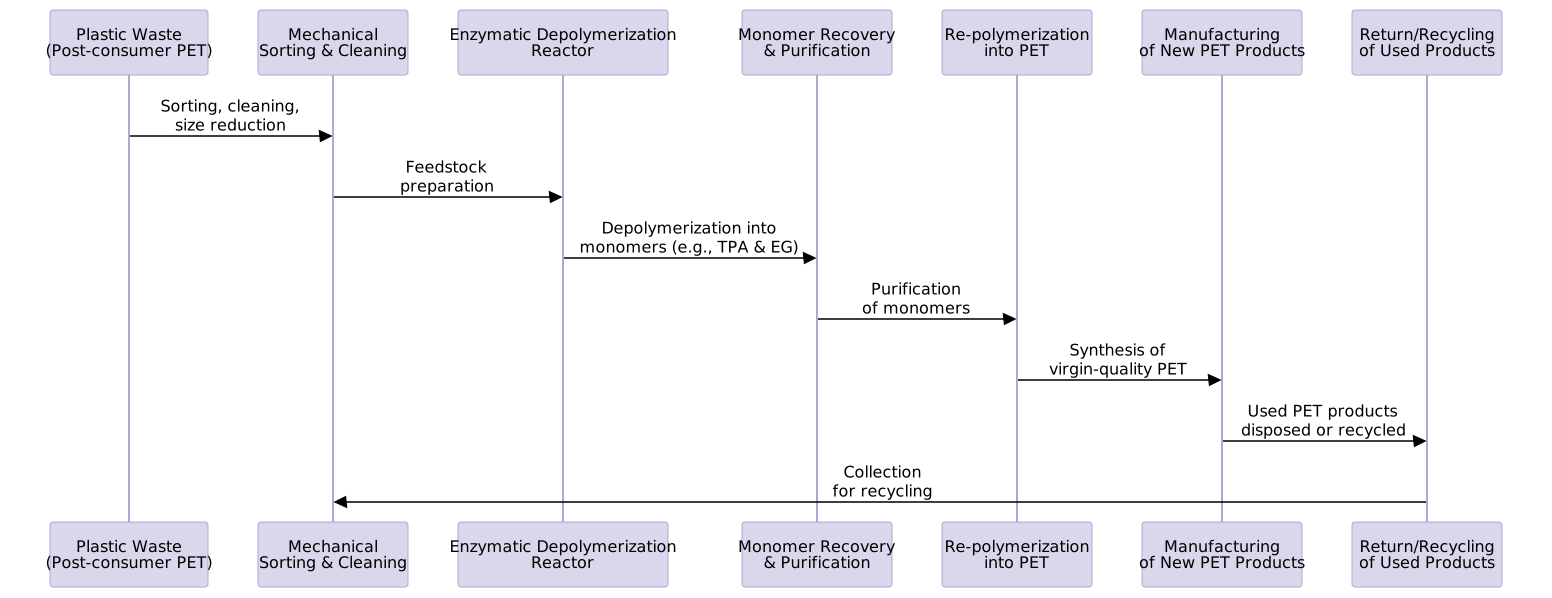
Narrative
- Waste Collection and Pre-Treatment: The process begins with the collection of post-consumer PET plastics, which undergo sorting, cleaning, and size reduction to remove contaminants and prepare feedstock [ 2 , 6 ].
- Enzymatic Depolymerization: The pre-treated plastic is introduced into bioreactors where engineered enzymes catalyze the breakdown of PET into its fundamental monomers—terephthalic acid (TPA) and ethylene glycol (EG) [ 2 , 6 , 16 , 17 ].
- Monomer Recovery & Purification: These monomers are separated and purified to high standards, enabling their reuse as raw materials for new PET synthesis [ 2 , 16 ].
- Re-Polymerization and Product Manufacturing: Purified monomers are subjected to chemical synthesis to produce virgin-quality PET, suitable for manufacturing food-grade bottles, fibers, or textiles [ 2 , 16 ].
- Product Use and Recycling Loop: Finished products are used, disposed of, and collected again, closing the loop and enabling repeated enzymatic recycling cycles [ 2 , 6 ].
Key Entities and Features in the Process
| Entity | Features | Role & Significance | References |
|---|---|---|---|
| Enzymes (PET hydrolases) | Engineered for efficiency, thermostability | Catalyze depolymerization, enabling green recycling | [ 2 , 6 , 16 , 17 ] |
| Microbial consortia | Microorganisms producing depolymerases | Assist in biodegradation and upcycling | [ 180 , 1170 ] |
| Reactor Systems | Bioreactors optimized for enzymatic activity | Facilitate controlled depolymerization | [ 6 , 16 , 17 ] |
| Chemical Process Units | Separation, purification, and polymerization | Reclaim monomers, produce new polymers | [ 2 , 16 ] |
| Industrial Infrastructure | Collection, sorting, and manufacturing plants | Integration point for scalable operation | [ 2 , 6 ] |
Complexities & Challenges
| Aspect | Complexity / Challenge | Implication | Mitigation Strategies |
|---|---|---|---|
| Contamination & Multilayer Structures | Contaminants hinder enzymatic access; multilayer films resist depolymerization | Reduced efficiency and output quality | Advanced sorting, chemical pre-treatment |
| Enzyme Stability & Activity | Enzymes degrade under industrial conditions | Lower process yields | Protein engineering, thermostable enzymes [ 16 , 17 , 157 ] |
| Process Scalability | Laboratory success not always scalable | High CAPEX and operational costs | Pilot projects, modular designs [ 16 , 17 ] |
| Energy & Water Consumption | High inputs in pre-treatment and purification | Environmental footprint | Process optimization, waste heat recovery [ 2 , 6 ] |
| Regulatory & Market Acceptance | Certification, consumer perception | Market deployment delays | Standardization, stakeholder engagement [ 26 , 137 ] |
Major Insights
1. Synergistic Integration of Enzymatic & Chemical Processes
Combining enzymatic depolymerization with traditional chemical purification enhances process sustainability and efficiency, enabling the production of monomers with purity comparable to virgin PET [ 2 , 16 ].
2. Advances in Enzyme Engineering
Progress in protein engineering, including rational design and directed evolution, has led to PETases with increased activity, thermostability, and substrate specificity, facilitating industrial application [ 157 , 174 ].
3. Industrial Demonstrations & Pilot Plants
Companies like Carbios are pioneering industrial-scale enzymatic recycling plants, with collaborations involving multinational corporations and governmental support, indicating readiness for commercial deployment [ 2 , 16 , 26 , 1137 ].
4. Circular Economy & Market Trends
The integration aligns with global sustainability goals, with key brands committing to using bio-recycled plastics, and markets projecting exponential growth in enzymatic recycling technologies [ 168 , 1115 , 1155 ].
5. Environmental & Economic Benefits
Enzymatic recycling drastically reduces greenhouse gas emissions, energy use, and reliance on fossil fuels, making it a promising path toward environmentally sustainable plastics management [ 2 , 16 , 26 , 150 ].
Opportunities & Future Directions
| Opportunity | Description | Potential Impact | Supporting Citations |
|---|---|---|---|
| Scaling Enzymatic Technologies | Development of robust, thermostable enzymes for industrial use | Increased process throughput, broader application | [ 157 , 174 , 179 ] |
| Process Optimization & Automation | Use of AI and machine learning for enzyme design and process control | Reduced costs, improved yields | [ 26 , 157 , 170 ] |
| Multilayer & Contaminated Waste Recycling | Innovations in pre-treatment and enzyme engineering | Expand feedstock scope | [ 137 , 174 , 177 ] |
| Integration with Biorefineries | Coupling enzymatic PET recycling with bio-based chemical production | Diversify products, enhance circularity | [ 151 , 182 ] |
| Regulatory & Policy Support | Incentives and standards for enzymatic recycling facilities | Accelerate adoption | [ 150 , 1114 ] |
Summary
The process integration in enzymatic recycling of plastics, especially PET, involves a multidisciplinary, multi-entity system designed to convert waste into high-quality raw materials via biochemical depolymerization, separation, and re-polymerization. This integrated approach addresses key challenges of contamination, scalability, and environmental impact, while unlocking opportunities for a sustainable, circular plastics economy. Advances in enzyme engineering, process automation, and industrial partnerships underpin this transformation, marking a pivotal shift toward greener plastic lifecycle management.
This detailed overview underscores the critical role of process integration in enabling the transition to sustainable and circular enzymatic recycling of plastics.
Citation Links
| 1 | https://www.recycling-magazine.com/2017/10/12/high-potential-enzymatic-recycling/ | recycling-magazine.com | 2017-10-12T00:00:00.000Z | |
| Arcording to the company the following step consisting in the synthesis of virgin PET made out of these oligomers has now been completed confirming by then the potential of Carbios' technology for ... | ||||
| 2 | http://www.finanzen.net/nachricht/aktien/carbios-first-production-of-virgin-pet-from-post-consumer-plastic-bottles-treated-by-enzymatic-hydrolysis-5745728 | finanzen.net | 2017-10-12T04:59:58.000Z | |
| Our next short-term goal is now to demonstrate that this virgin PET is suitable for the production of new bottles, thus paving the way to circular economy for PET plastic products. Jacqueline ... | ||||
| 5 | https://www.recycling-magazine.com/2019/04/29/nestle-waters-pepsico-and-suntory-beverage-food-europe-join-consortium/ | recycling-magazine.com | 2019-04-29T00:00:00.000Z | |
| The Consortium offers us the opportunity to accelerate the development of this promising enzymatic recycling technology which, alongside mechanical and chemical recycling, can move us closer to a circular economy for plastics." (2019) | ||||
| 6 | https://www.recycling-magazine.com/2019/04/29/nestle-waters-pepsico-and-suntory-beverage-food-europe-join-consortium/ | recycling-magazine.com | 2019-04-29T00:00:00.000Z | |
| Simon Lowden, President of Global Foods at PepsiCo adds, "PepsiCo is striving for a world where plastics need never become waste. Achieving that requires collaborative efforts to drive ... | ||||
| 16 | https://www.marketscreener.com/quote/stock/CARBIOS-15262917/news/Carbios-takes-textile-circularity-a-step-further-with-its-enzymatic-recycling-technology-39716965/?utm_medium=RSS&utm_content=20220310 | marketscreener.com | 2022-03-10T06:33:06.000Z | |
| The enzymatic recycling technology developed by Carbios deconstructs any type of PET plastic waste into its basic components, which can then be reused to produce new PET plastics of a quality equivalent to virgin ones. This PET innovation, the first of its kind in the world, was recently recognized in a scientific paper published in the prestigious journal Nature . Additionally, Carbios is working hand in hand with multinational brands - like L'Oreal, Nestle Waters, PepsiCo and Suntory Beverage & Food Europe - to implement its technology, and to lead the transition toward a truly circular economy. The Company has also developed an enzymatic biodegradation technology for PLA (a bio sourced polymer) based single use plastics. | ||||
| 17 | https://www.marketscreener.com/quote/stock/CARBIOS-15262917/news/Carbios-takes-textile-circularity-a-step-further-with-its-enzymatic-recycling-technology-39716965/?utm_medium=RSS&utm_content=20220310 | marketscreener.com | 2022-03-10T06:33:06.000Z | |
| Carbios' process will be one of the solutions that will enable this waste to be sustainably recovered and included in a true circular economy model. These technological validations were carried out ... | ||||
| 26 | https://finance.yahoo.com/news/carbios-build-france-first-kind-200000221.html | finance.yahoo.com | 2022-06-28T04:29:47.000Z | |
| This collaboration reflects both parties' ambition to address the growing concern of plastics pollution through the development of Carbios' enzymatic bio-recycling process. This disruptive technology could accelerate the transition to a plastics Circular Economy. | ||||
| 137 | https://en.wikipedia.org/?curid=63674284 | 2025-07-19T12:12:31.000Z | ||
| Moreover, contamination from colorants , adhesives, and food leftovers restricts recyclability and diminishes output quality. Due to the lack of effective separation or recycling methods, the ... | ||||
| 150 | https://www.globenewswire.com/news-release/2025/08/14/3133675/28124/en/Plastic-Recycling-Market-Growth-Analysis-Report-2025-2033-Global-Surge-Driven-by-Tech-Advancements-and-Sustainability-Mandates.html | GlobeNewswire News Room | 2025-08-14T15:12:19.000Z | |
| Increasing efforts to promote a circular economy have led to a boom in recycling initiatives, as industries face pressure to diminish their reliance on virgin plastic production. Recent advancements | ||||
| 151 | https://doi.org/10.3390/polym17162224 | Bekzhan D. Kossalbayev | 2025-08-15T00:00:00.000Z | |
| Advances in processing technology, such as twin-screw extrusion of fiber-reinforced composites, solvent-free reactive extrusion for lignin-based plastics and enzymatic or deep eutectic solvent pre-treatments to improve fiber dispersion, are critical for scaling up production; here, scaling up refers to transitioning from laboratory-scale demonstrations to pilot and industrial-scale manufacturing while maintaining material performance and process efficiency. Integration with existing papermaking and plastics processing lines requires specific modifications and co-located biorefineries can valorize multiple waste fractions into packaging materials, chemicals and biofuels. End-of-life strategies must be matched to material composition: fiber-based packaging can enter paper recycling streams, while starch- or PHA-rich composites can be industrially composted under controlled conditions. Continued materials-science research, such as improving compatibilisation between hydrophilic fibers and hydrophobic matrices and optimizing barrier properties, alongside targeted engineering improvements in processing equipment, will determine whether plant waste-based packaging can achieve commercial competitiveness and contribute significantly to a circular bioeconomy | ||||
| 157 | https://doi.org/10.1016/j.checat.2025.101399 | Thomas M. Groseclose | 2025-08-21T00:00:00.000Z | |
| Enzymatic depolymerization of poly(ethylene terephthalate) (PET) has emerged as a promising approach for polyester recycling, and, to date, many natural and engineered PET hydrolase enzymes have ... | ||||
| 168 | https://www.finanznachrichten.de/nachrichten-2025-09/66333358-vantage-market-research-industrial-enzymes-market-size-trends-growth-projected-usd-17-77-billion-by-2035-at-7-65-cagr-008.htm | FinanzNachrichten.de | 2025-09-02T16:48:45.000Z | |
| Performance Substitution: Competing chemistries, new catalysts, or in-house enzymatic solutions at large CPGs/biofuel producers can pressure pricing and share. IP & Strain Security: ... | ||||
| 170 | https://www.just-style.com/news/samsara-eco-manufacturing-plant/ | just-style.com | 2025-09-03T11:54:19.000Z | |
| Samsara Eco said it remains active in addressing the challenge of textile recycling, where currently only approximately 10% of plastics are recycled globally, and less than 1% of textiles are turned back into new textile products. The Jerrabomberra site also lays the groundwork for Samsara Eco's upcoming commercial nylon 6,6 plant in Asia, set to open in 2028. Developed with engineering partner KBR, this 20,000 tonne facility will be the first in a series of international commercial sites utilising EosEco technology to convert waste into materials identical to virgin raw materials. Samsara Ecos new plant opening has garnered support from an investor consortium including Main Sequence, Temasek, Greycroft, and Hitachi Ventures. Hitachi Ventures associate Jan Marchewski said: This hub will enable Samsara Eco to test AI-discovered enzymes at scale in collaboration with partners, further cementing its market leadership in enzymatic recycling. "Samsara Eco launches first low-carbon circular materials production plant" was originally created and published by Just Style, a GlobalData owned brand. | ||||
| 174 | https://doi.org/10.1002/pro.70282 | Nitay Ahituv | 2025-09-13T00:00:00.000Z | |
| Finally, we review selected engineering campaigns and suggest future directions for the enzymatic recycling of PET under mesophilic and thermophilic conditions, aiming to understand the gaps to ... | ||||
| 177 | https://pubmed.ncbi.nlm.nih.gov/40955595/ | Nailah N Moghal | 2025-09-16T18:17:55.000Z | |
| Recent progress in circular 3D-printable photocurable resins that enable closed-loop recycling marks a significant step forward in reducing wasteful manufacturing methods and non-recyclable printed ... | ||||
| 179 | https://www.globenewswire.com/news-release/2025/09/17/3151793/0/en/Sustainable-Plastics-Market-Size-to-Worth-USD-1-448-23-Billion-by-2034.html | GlobeNewswire News Room | 2025-09-17T14:51:50.000Z | |
| Shift to bio based plastics- increasing use of materials like PLA, PHA, and bio PET as alternatives to petroleum based plastics. Circular economy adoption- Companies are investing in closed loop ... | ||||
| 180 | https://doi.org/10.3390/biology14091307 | Marta Muñoz-Martí | 2025-09-22T00:00:00.000Z | |
| Therefore, alternative and complementary strategies to address PU pollution have emerged as a pressing global concern, with biodegradation and biological recycling being considered since the late ... | ||||
| 182 | https://dx.doi.org/10.26434/chemrxiv-2025-ghfmk?rft_dat=source%3Ddrss | https://dx.doi.org | 2025-09-23T04:37:48.000Z | |
| This enzymatic solvolysis approach in alcohol media was extended to non-isocyanate polyurethane foams, opening new paths for depolymerizing and recycling complex plastics, thereby contributing to a ... | ||||
| 1114 | http://www.cnbc.com/2018/03/28/business-wire-carbios-2017-annual-results.html | cnbc.com | 2018-03-28T05:45:00.000Z | |
| As of December 31, 2017, the operating income of this contract corresponds to €724,000. The close collaboration which has been set up with CARBIOS has already enabled CARBIOLICE to apply for the ... | ||||
| 1115 | https://www.prnewswire.com/news-releases/a-new-milestone-in-biotherms-sustainable-commitment-301000376.html | prnewswire.com | 2020-02-06T16:09:54.000Z | |
| By 2023, the brand will ensure that all products are made of a minimum of 50% recycled plastic and will start to use bio-recycled plastic (enzymatic recycling process)*. In 2025, Biotherm will be ... | ||||
| 1137 | http://press.envinews.co.kr/newsRead.php?no=968056 | press.envinews.co.kr | 2023-09-26T21:54:29.000Z | |
| Roland Lescure, French Minister for Industry: "I'm delighted to be able to announce, at the opening of the World Plastics Conference, the French State's support of nearly €54 million for Carbios' innovative enzymatic plastic recycling projects. The construction in France in 2023 of the world's first enzymatic plastic recycling plant is an important step towards building a fully circular plastic economy, one of the greatest environmental challenges of the next two decades. | ||||
| 1155 | https://www.solvay.com/en/press-release/solvay-and-carbios-demonstrate-enzymatic-depolymerization-petpvdc-barrier-film | solvay.com | 2023-12-10T11:11:31.000Z | |
| As the industry's first solution for the recycling of complex multi-layer structures such as PVDC coated PET films, our enzymatic biological recycling makes a significant contribution to help the ... | ||||
| 1170 | https://doi.org/10.3390/polym17050675 | Volodymyr Skorokhoda | 2025-03-02T00:00:00.000Z | |
| Special emphasis was placed on Antarctic bacterial strains due to their anticipated enhanced enzymatic activity toward the studied polymers under standard cultivation conditions. This aligns with ... |