Robustness Fault-Tolerance in AI-Optimized Swarm Drones
Sequence Diagram and Narrative on Fault-Tolerance in Swarm Drone Systems
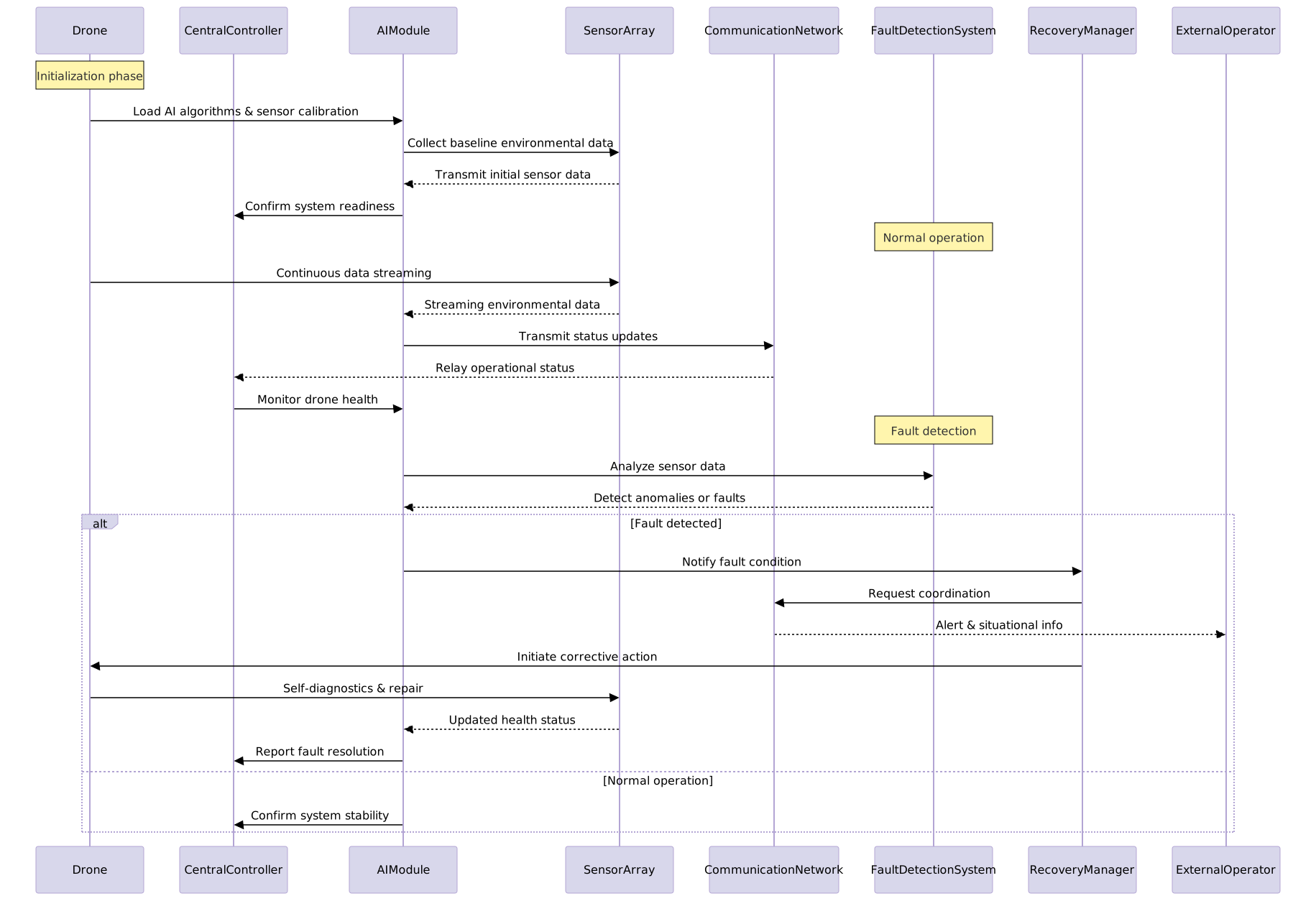
The robustness and fault-tolerance of AI-optimized swarm drone systems is critical for ensuring operational reliability, safety, and resilience in dynamic environments. To illustrate the complex interactions involved, the following Mermaid sequence diagram captures the core processes and entities involved in fault detection, diagnosis, and recovery within a drone swarm:
Narrative Explanation:
This sequence delineates the continuous cycle of data acquisition, fault detection, and response:
- Initialization: Drones load AI algorithms and calibrate sensors. Sensor arrays gather environmental baseline data, and the AI module confirms system readiness.
- Normal Operation: Drones collect real-time environmental data, which is analyzed by AI modules. Status updates are relayed via communication networks to central controllers, ensuring system health.
- Fault Detection: The AI analyzes incoming sensor data to detect anomalies. When faults are detected, the system triggers fault management protocols.
- Fault Response & Recovery: Fault notifications prompt recovery managers to coordinate corrective actions—ranging from autonomous drone repairs to reconfiguration of swarm behavior. External operators are informed for oversight or manual intervention if necessary.
- Post-Recovery: Once faults are mitigated, systems report back to central controllers, resuming normal operations.
This sequence exemplifies how layered fault detection, analysis, and autonomous recovery contribute to system robustness, critical in unpredictable operational environments such as military, disaster response, or industrial inspection missions [ 1 ].
Key Concepts in Robustness Fault-Tolerance
| Concept | Description | Impact on Swarm Drones | Supporting Extracts |
|---|---|---|---|
| Redundancy | Multiple systems or drones capable of performing the same task | Ensures continuity despite individual drone failures | [ 298 , 299 ] |
| Fault Detection & Diagnosis | Mechanisms to identify anomalies early | Prevents cascade failures, maintains system integrity | [ 298 , 299 ] |
| Autonomous Recovery | Self-healing actions to restore functionality | Critical for real-time resilience | [ 299 , 310 ] |
| Robust Communication | Reliable data exchange even under interference | Maintains swarm coordination | [ 298 , 299 , 311 ] |
| Adaptive Algorithms | Dynamic reconfiguration based on environment | Enhances fault tolerance in unpredictable scenarios | [ 298 , 299 , 303 ] |
| Environmental Sensing | Accurate environment monitoring for fault detection | Enables predictive maintenance | [ 98 , 231 , 246 ] |
Critical Features and Processes
Features of Fault-Tolerant Swarm Drones
| Feature | Description | Significance |
|---|---|---|
| Decentralized Control | Drones operate without centralized command, sharing load | Enhances robustness to single-point failures |
| Multi-modal Sensors | Use of diverse sensors (LiDAR, thermal, visual) | Improves fault detection accuracy |
| Self-Localization & Navigation | Autonomous movement with fault-aware routing | Avoids hazards and system breakdowns |
| Edge AI Processing | On-board AI for real-time decision-making | Reduces latency, critical for fault response |
| Redundant Communication Channels | Multiple links for data exchange | Maintains connectivity in interference-heavy environments |
Fault-Tolerance Processes

Key Points:
- Fault detection is proactive, relying on AI-driven anomaly recognition.
- Diagnosis assesses fault severity and origin.
- Recovery involves autonomous repair, reconfiguration, or fallback strategies.
- Continuous monitoring ensures system stability and readiness for subsequent faults [ 298 , 299 , 310 ].
Major Challenges and Opportunities
| Challenges | Opportunities |
|---|---|
| Environmental unpredictability | Development of more adaptive AI models [ 1 , 298 ] |
| Limited onboard processing power | Edge AI hardware optimization [ 226 , 298 ] |
| Communication disruptions | Robust, multi-channel communication protocols [ 298 , 311 ] |
| Complex fault scenarios | Advanced AI for multi-fault diagnosis and prediction [ 299 , 303 ] |
| Integration with heterogeneous systems | Interoperable multi-platform architectures [ 299 , 310 ] |
Impact Analysis: Fault-Tolerance in AI-Optimized Swarm Drones
| Aspect | Effect | Citation |
|---|---|---|
| Reliability | Increased mission success rate | [ 298 , 299 ] |
| Safety | Reduced risk of catastrophic failure | [ 298 , 299 , 310 ] |
| Resilience | Enhanced operation in hostile environments | [ 231 , 246 ] |
| Scalability | Facilitation of large-scale drone swarms | [ 298 , 299 ] |
| Cost Efficiency | Reduced need for manual intervention | [ 298 , 310 ] |
Opportunities for Advancement
- Bio-inspired fault-tolerance mechanisms (e.g., swarm resilience inspired by biological systems) [ 86 ].
- Integration of AI with advanced sensor fusion to improve early fault detection [ 231 , 246 ].
- Development of decentralized AI models to eliminate single points of failure [ 299 , 310 ].
- Enhanced simulation environments for testing fault scenarios and robustness strategies [ 97 , 301 ].
- Hybrid cloud-edge architectures enabling scalable, fault-tolerant swarm management [ 226 , 298 ].
Summary
Robustness and fault-tolerance are fundamental to the deployment of AI-optimized swarm drones in critical and unpredictable environments. Achieving resilience involves layered mechanisms encompassing autonomous fault detection, diagnosis, and recovery, supported by advanced AI algorithms, diversified sensing, and resilient communication protocols. Despite challenges like environmental unpredictability and hardware limitations, ongoing research leverages bio-inspired methods, edge computing, and decentralized control to unlock new levels of operational reliability. This continuous evolution promises to expand the applicability of drone swarms across military, industrial, environmental, and emergency response domains, making them vital components of future autonomous systems.
Please let me know if you need further elaboration or specific case studies related to robustness in swarm drone systems.
Citation Links
| 1 | https://ppubs.uspto.gov/pubwebapp/external.html?q=(20190138934).pn | Saurav Prakash | 2019-05-09T00:00:00.000Z | |
| Example use cases for GD algorithms include localization in wireless sensor networks and distributed path-planning for drones. (2019) | ||||
| 86 | https://doi.org/10.3390/biomimetics8030278 | Zoran Jakšić | 2023-06-28T00:00:00.000Z | |
| Questions are even posed as to whether AI can show its own creativity comparable to that of humans . | ||||
| 97 | https://www.cna.org/our-media/newsletters/china-ai-and-autonomy-report/issue-15 | cna.org | 2023-09-25T17:34:37.000Z | |
| According to the article, however, the satellite tracking the Harry S. Truman was able to detect the ship automatically using specially designed AI chips that are able to meet the space, weight, and | ||||
| 98 | https://www.cna.org/our-media/newsletters/china-ai-and-autonomy-report/issue-15 | cna.org | 2023-09-25T17:34:37.000Z | |
| Images from Science Robotics journal article showing autonomous swarm transiting a bamboo forest via an AI-optimized trajectory while avoiding obstacles and inter-swarm drones. | ||||
| 226 | https://techrights.org/2019/05/30/gparted-1-0-and-new-krita/ | techrights.org | 2019-05-30T00:00:00.000Z | |
| Announced at this week's Computex show in Taiwan, Nvidia EGX is billed as an "On-Prem AI Cloud-in-a-Box" that can run cloud-native container software on edge ... | ||||
| 231 | https://lifeboat.com/blog/author/dan-kummer/page/188 | lifeboat.com | 2022-06-27T23:28:35.000Z | |
| Computers could revise past conclusions with AI - May 4, 2022 What The Next-Generation Silent Drone Looks Like - May 4, ... | ||||
| 246 | https://spooool.ie/2023/08/the-importance-of-acid-properties-in-ai-driven-databases/ | spooool.ie | 2023-08-01T00:00:00.000Z | |
| ... continues to shape the future of data analysis and decision-making, understanding and implementing ACID properties will be crucial for organizations seeking to leverage the power of AI-driven databases. Previous PostPrevious The Benefits of AI-Optimized Hardware in Healthcare and Medical Research Next PostNext The Benefits of Biometric-as-a-Service Solutions in Enhancing Security Categories Select Category3D Printing (6)5G Technology (8)Adaptive Learning (11)Adaptive Learning Platforms (3 | ||||
| 298 | https://techrights.org/2019/05/30/gparted-1-0-and-new-krita/ | techrights.org | 2019-05-30T00:00:00.000Z | |
| Arm launches AI-optimized chips for Android edge biometrics as Sony plans processor ... | ||||
| 299 | https://ppubs.uspto.gov/pubwebapp/external.html?q=(20220114301).pn | Venkataraman NATARAJAN | 2022-04-14T00:00:00.000Z | |
| It may be desirable to obtain a factory system including several AWL-based autonomous machine clusters that are capable working together on multiple tasks as required in a typical workflow. It may ... | ||||
| 301 | http://arxiv-export-lb.library.cornell.edu/list/cs.AI/2201?show=907 | arxiv-export-lb.library.cornell.edu | 2022-09-28T00:40:58.000Z | |
| 244] arXiv:2201.01770 (cross-list from cs. Title: NumHTML: Numeric-Oriented Hierarchical Transformer Model for Multi-task Financial Forecasting Authors: Linyi Yang, Jiazheng Li, Ruihai Dong, Yue ... | ||||
| 303 | https://www.researchgate.net/publication/222511538_Wireless_sensors_in_agriculture_and_food_industry-Recent_development_and_future_perspective | researchgate.net | 2023-03-29T17:49:25.000Z | |
| This article contributes to the field by surveying AI applications in the agricultural sector. It is also shown that while utilizing AI applications, quality, productivity, and sustainability are ... | ||||
| 310 | https://www.digitaltrends.com/users/dfurness/page/6/ | digitaltrends.com | 2023-06-06T17:45:57.000Z | |
| Researchers have turned to sharkskin to inspire designs for drones and planes to fly with better lift and less drag. A.I. perfectly predicted last year's Super Bowl score. What happens to betting? ... | ||||
| 311 | https://worldwide.espacenet.com/patent/search?q=EP4202591A1 | Venkataraman NATARAJAN | 2023-06-28T00:00:00.000Z | |
| FIG. 6 shows an illustration of an exemplary AI/ML module; FIG. 7 shows an example of a flow diagram showing an on-the-fly policy ... |